 |
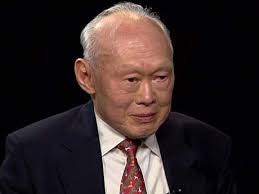
| Lee Kuan Yew - tougher than a nail |
EDITOR'S PICK This is a very wide-ranging interview encompassing politics, religion, philosophy and love. Singapore's Minister Mentor Lee Kuan Yew shares a very tender side that perhaps he would never have allowed himself to reveal when he was younger.
“I am an agnostic. I was brought up in a traditional Chinese family with ancestor worship. I would go to my grandfather’s grave on All Soul’s Day which is called “Qingming”. My father would bring me along, lay out food and candles and burn some paper money and kowtow three times over his tombstone. At home on specific days outside the kitchen he would put up two candles with my grandfather’s picture. But as I grew up, I questioned this because I think this is superstition. "She (his wife Geok Choo) has been for two years bed-ridden, unable to speak after a series of strokes. I am not going to convert her. I am not going to allow anybody to convert her because I know it will be against what she believed in all her life. How do I comfort myself? Well, I say life is just like that. You can’t choose how you go unless you are going to take an overdose of sleeping pills, like sodium amytal. For just over two years, she has been inert in bed, but still cognitive. She understands when I talk to her, which I do every night. She keeps awake for me; I tell her about my day’s work, read her favourite poems.”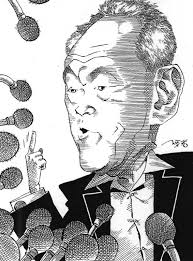 The following is the transcript of the interview Seth Mydans had with Minister Mentor Lee Kuan Yew, for the New York Times and the International Herald Tribune. The interview was held on 1 September 2010.
Mr Lee: “Thank you. When you are coming to 87, you are not very happy..”
Q: “Not. Well you should be glad that you’ve gotten way past where most of us will get.”
Mr Lee: “That is my trouble. So, when is the last leaf falling?”
Q: “Do you feel like that, do you feel like the leaves are coming off?”
Mr Lee: “Well, yes. I mean I can feel the gradual decline of energy and vitality and I mean generally every year when you know you are not on the same level as last year. But that is life.”
 |
| With his wife of 60 years- Kwa Geok Choo |
Q: “My mother used to say never get old.”
Mr Lee: “Well, there you will try never to think yourself old. I mean I keep fit, I swim, I cycle.”
Q: “And yoga, is that right? Meditation?”
Mr Lee: “Yes.”
Q: “Tell me about meditation?”
Mr Lee: “Well, I started it about two, three years ago when Ng Kok Song, the Chief Investment Officer of the Government of Singapore Investment Corporation, I knew he was doing meditation. His wife had died but he was completely serene. So, I said, how do you achieve this? He said I meditate everyday and so did my wife and when she was dying of cancer, she was totally serene because she meditated everyday and he gave me a video of her in her last few weeks completely composed completely relaxed and she and him had been meditating for years. Well, I said to him, you teach me. He is a devout Christian. He was taught by a man called Laurence Freeman, a Catholic. His guru was John Main a devout Catholic. When I was in London, Ng Kok Song introduced me to Laurence Freeman. In fact, he is coming on Saturday to visit Singapore, and we will do a meditation session. The problem is to keep the monkey mind from running off into all kinds of thoughts. It is most difficult to stay focused on the mantra. The discipline is to have a mantra which you keep repeating in your innermost heart, no need to voice it over and over again throughout the whole period of meditation. The mantra they recommended was a religious one. Ma Ra Na Ta, four syllables. Come To Me Oh Lord Jesus. So I said Okay, I am not a Catholic but I will try. He said you can take any other mantra, Buddhist Om Mi Tuo Fo, and keep repeating it. To me Ma Ran Na Ta is more soothing. So I used Ma Ra Na Ta. You must be disciplined. I find it helps me go to sleep after that. A certain tranquility settles over you. The day’s pressures and worries are pushed out. Then there’s less problem sleeping. I miss it sometimes when I am tired, or have gone out to a dinner and had wine. Then I cannot concentrate. Otherwise I stick to it.”
Q: “So…”
Mr Lee: “.. for a good meditator will do it for half-an-hour. I do it for 20 minutes.”
Q: “So, would you say like your friend who taught you, would you say you are serene?”
Mr Lee: “Well, not as serene as he is. He has done it for many years and he is a devout Catholic. That makes a difference. He believes in Jesus. He believes in the teachings of the Bible. He has lost his wife, a great calamity. But the wife was serene. He gave me this video to show how meditation helped her in her last few months. I do not think I can achieve his level of serenity. But I do achieve some composure.”
Q: “And do you find that at this time in your life you do find yourself getting closer to religion of one sort or another?”
Mr Lee: “I am an agnostic. I was brought up in a traditional Chinese family with ancestor worship. I would go to my grandfather’s grave on All Soul’s Day which is called “Qingming”. My father would bring me along, lay out food and candles and burn some paper money and kowtow three times over his tombstone. At home on specific days outside the kitchen he would put up two candles with my grandfather’s picture. But as I grew up, I questioned this because I think this is superstition. You are gone, you burn paper money, how can he collect the paper money where he is? After my father died, I dropped the practice. My youngest brother baptised my father as a Christian. He did not have the right to. He was a doctor and for the last weeks before my father’s life, he took my father to his house because he was a doctor and was able to keep my father comforted. I do not know if my father was fully aware when he was converted into Christianity.”
Q: “Converted your father?”
Mr Lee: “Yes.”
Q: “Well this happens when you get close to the end.”
Mr Lee: “Well, but I do not know whether my father agreed. At that time he may have been beyond making a rational decision. My brother assumed that he agreed and converted him.”
Q: “But…”
Mr Lee: “I am not converted.”
Q: “But when you reach that stage, you may wonder more than ever what is next?”
Mr Lee: “Well, what is next, I do not know. Nobody has ever come back. The Muslims say that there are seventy houris, beautiful women up there. But nobody has come back to confirm this.”
Q: “And you haven’t converted to Islam, knowing that?”
Mr Lee: “Most unlikely. The Buddhist believes in transmigration of the soul. If you live a good life, the reward is in your next migration, you will be a good being, not an ugly animal. It is a comforting thought, but my wife and I do not believe in it. She has been for two years bed-ridden, unable to speak after a series of strokes. I am not going to convert her. I am not going to allow anybody to convert her because I know it will be against what she believed in all her life. How do I comfort myself? Well, I say life is just like that. You can’t choose how you go unless you are going to take an overdose of sleeping pills, like sodium amytal. For just over two years, she has been inert in bed, but still cognitive. She understands when I talk to her, which I do every night. She keeps awake for me; I tell her about my day’s work, read her favourite poems.”
Q: ‘And what kind of books do you read to her?”
Mr Lee: “So much of my time is reading things online. The latest book which I want to read or re-read is Kim. It is a beautiful of description of India as it was in Kipling’s time. And he had an insight into the Indian mind and it is still basically that same society that I find when I visit India. “
Q: “When you spoke to Time Magazine a couple of years ago, you said Don Quixote was your favourite?”
Mr Lee: “Yes, I was just given the book, Don Quixote, a new translation.”
Q: “But people might find that ironic because he was fantasist who did not realistically choose his projects and you are sort of the opposite?”
Mr Lee: “No, no, you must have something fanciful and a flight of fancy. I had a colleague Rajaratnam who read Sci-Fi for his leisure.”’
Q: “And you?”:
Mr Lee: “No, I do not believe in Sci-Fi.”
Q: “But you must have something to fantasise.”
Mr Lee: “Well, at the moment, as I said, I would like to read Kim again. Why I thought of Kim was because I have just been through a list of audio books to choose for my wife. Jane Austen, Emily Bronte, books she has on her book shelf. So, I ticked off the ones I think she would find interesting. The one that caught my eye was Kim. She was into literature, from Alice in Wonderland, to Adventures with a Looking Glass, to Jane Austen’s Persuasion, Pride and Prejudice, and Sense and Sensibility. Jane Austen was her favourite writer because she wrote elegant and leisurely English prose of the 19th century. The prose flowed beautifully, described the human condition in a graceful way, and rolls off the tongue and in the mind. She enjoyed it. Also Chaucer’s Canterbury Tales. She was an English Literature major.”
Q: “You are naming books on the list, not necessarily books you have already read, yes?”
Mr Lee: “I would have read some of them.”
Q: “Like a Jane Austen book, or Canterbury Tales?”
Mr Lee: “No, Canterbury Tales, I had to do it for my second year English Literature course in Raffles College. For a person in the 15th Century, he wrote very modern stuff. I didn’t find his English all that archaic. I find those Scottish poets difficult to read. Sometimes I don’t make sense of their Scottish brogue. My wife makes sense of them. Then Shakespeare’s sonnets.”
Q: “You read those?”
Mr Lee: “I read those sonnets when I did English literature in my freshman’s year. She read them.”
Q: “When you say she reads them now, you’re the one who reads them, yes?”
Mr Lee: “Yes, I read them to her.”
Q: “But you go to her.”
Mr Lee: “Yes, I read from an Anthology of Poems which she has, and several other anthologies. So I know her favourite poems. She had flagged them. I read them to her.”
Q: “She’s in the hospital? You go to the hospital?”
Mr Lee: “No, no, she’s at home. We’ve got a hospital bed and nurses attending to her. We used to share the same room. Now I’m staying in the next room. I have to get used to her groans and grunts when she’s uncomfortable from a dry throat and they pump in a spray moisture called “Biothene” which soothes her throat, and they suck out phlegm. Because she can’t get up, she can’t breathe fully. The phlegm accumulates in the chest but you can’t suck it out from the chest, you’ve got to wait until she coughs and it goes out to her throat. They suck it out, and she’s relieved. They sit her up and tap her back. It’s very distressing, but that’s life.”
Q: “Yes, your daughter on Sunday wrote a moving column, movingly about the situation referring to you.”
Mr Lee: “How did you come to read it?”
Q: “Somebody said you’ve got to read that column, so I read it.”
Mr Lee: “You don’t get the Straits Times.”
Q: “I get it online actually. I certainly do, I follow Singapore online and she wrote that the whole family suffers of course from this and she wrote the one who’s been hurting the most and is yet carrying on stoically is my father.”
Mr Lee: “What to do? What else can I do? I can’t break down. Life has got to go on. I try to busy myself, but from time to time in idle moments, my mind goes back to the happy days we were up and about together.”
Q: “When you go to visit her, is that the time when your mind goes back?”
Mr Lee: “No, not then. My daughter’s fished out many old photographs for this piece she wrote and picked out a dozen or two dozen photographs from the digital copies which somebody had kept at the Singapore Press Holdings. When I look at them, I thought how lucky I was. I had 61 years of happiness. We’ve got to go sometime, so I’m not sure who’s going first, whether she or me. So I told her, I’ve been looking at the marriage vows of the Christians. The best I read was,” To love, to hold and to cherish, in sickness and in health, for better or for worse, till death do us part.” I told her I would try and keep you company for as long as I can. She understood.”
Q: “Yes, it’s been really.”
Mr Lee: “What to do? What can you do in this situation? I can say get rid of the nurses. Then the maids won’t know how to turn her over and then she gets pneumonia. That ends the suffering. But human beings being what we are, I do the best for her and the best is to give her a competent nurse who moves her, massages her, turns her over, so no bed sores. I’ve got a hospital bed with air cushions so no bed sores. Well, that’s life. Make her comfortable.”
Q: “And for yourself, you feel the weight of age more than you have in the past?”
Mr Lee: “I’m not sure. I marginally must have. It’s stress. However, I look at it, I mean, it’s stress. That’s life. But it’s a different kind of stress from the kind of stress I faced, political stresses. Dire situations for Singapore, dire situations for myself when we broke off from Malaysia, the Malays in Singapore could have rioted and gone for me and they suddenly found themselves back as a minority because the Tunku kicked us out. That’s different, that’s intense stress and it’s over but this is stress which goes on. One doctor told me, you may think that when she’s gone you’re relieved but you’ll be sad when she’s gone because there’s still the human being here, there’s still somebody you talk to and she knows what you’re saying and you’ll miss that. Well, I don’t know, I haven’t come to that but I think I’ll probably will because it’s now two years, May, June, July, August, September, two years and four months. It’s become a part of my life.”
Q: “She’s how old now?”
Mr Lee: “She’s two-and-a-half years older than me, so she’s coming on to 90.”
Q: “But you did make a reference in an interview with Time magazine to something that goes beyond reason as you put it. You referred to the real enemy by Pierre D’Harcourt who talked about people surviving the Nazi, it’s better that they have something to believe in.”
Mr Lee: “Yes, of course.”
Q: “And you said that the Communists and the deeply religious fought on and survived. There are some things in the human spirit that are beyond reason.”
Mr Lee: “I believe that to be true. Look, I saw my friend and cabinet colleague who’s a deeply religious Catholic. He was Finance Minister, a fine man. In 1983, he had a heart attack. He was in hospital, in ICU, he improved and was taken out of ICU. Then he had a second heart attack and I knew it was bad. I went to see him and the priest was giving him the last rites as a Catholic. Absolutely fearless, he showed no distress, no fear, the family was around him, his wife and daughters, he had four daughters. With priest delivering the last rites, he knew he was reaching the end. But his mind was clear but absolutely calm.”
Q: “Well, I am more like you. We don’t have something to cling to.”
Mr Lee: “That’s our problem.”
Q: “But also the way people see you is supremely reasonable person, reason is the ultimate.”
Mr Lee: “Well, that’s the way I’ve been working.”
Q: “Well, you did mention to Tom Plate, they think they know me but they only know the public me?”
Mr Lee: “Yeah, the private view is you have emotions for your close members of your family. We are a close family, not just my sons and my wife and my parents but my brothers and my sister. So my youngest brother, a doctor as I told you, he just sent me an email that my second brother was dying of a bleeding colon, diverticulitis. And later the third brother now has got prostate cancer and has spread into his lymph nodes. So I asked what’re the chances of survival. It’s not gotten to the bones yet, so they’re doing chemotherapy and if you can prevent it from going into the bones, he’ll be okay for a few more years. If it does get to the bones, then that’s the end. I don’t think my brother knows. But I’ll probably go and see him.”
Q: “But you yourself have been fit. You have a stent, you had heart problem late last year but besides that do you have ailments?”
Mr Lee: “Well, aches and pains of a geriatric person, joints, muscles but all non-terminal. I go in for a physiotherapy, maintenance once a week, they give me a rub over because when I cycle, my thighs get sore, knees get a little painful, and so the hips.”
Q: “These are the signs of age.”
Mr Lee: “Yeah, of course.”
Q: “I’m 64. I’m beginning to feel that and I don’t like it and I don’t want to admit to myself.”
Mr Lee: “But if you stop exercising, you make it worse. That’s what my doctors tell me, just carry on. When you have these aches and pains, we’ll give you physiotherapy. I’ve learnt to use heat pads at home. So after the physiotherapy, once a week, if I feel my thighs are sore, I just have a heat pad there. You put in the microwave oven and you tie it around your thighs or your ankles or your calves. It relieves the pain.”
Q: “So you continue to cycle.”
Mr Lee: “Oh yeah.”
Q: “Treadmill?
Mr Lee: “No, I don’t do the treadmill. I walk but not always. When I’ve cycled enough I don’t walk.”
Q: “That’s your primary exercise, swimming?”
Mr Lee: “Yeah, I swim everyday, it’s relaxing.”
Q: “What other secrets, I see you drink hot water?”
Mr Lee: “Yes.”
Q: “Tell me about it.”
Mr Lee: “Well, I used to drink tea but tea is a diuretic, but I didn’t know that. I used to drink litres of it. In the 1980s, I was having a conference with Zhou Ziyang who was then Secretary-General of the Communist Party in the Great Hall of the People. The Chinese came in and poured more tea and hot water. I was scoffing it down because it kept my throat moistened, my BP was up because more liquid was in me. Halfway through, I said please stop. I’m dashing off. I had to relief myself. Then my doctors said don’t you know that tea is a diuretic? I don’t like coffee, it gives me a sour stomach, so okay, let’s switch to water.”
Q: “You know you had the hot water when I met you a couple of years ago and after I told my wife about that, she switched to hot water. She’s not sure why except that you drink hot water, so she’s decided to.”
Mr Lee: “Well, cold water, this was from my ENT man. If you drink cold water, you reduce the temperature of your nasal passages and throat and reduce your resistance to coughs and colds. So I take warm water, body temperature. I don’t scald myself with boiling hot water. I avoid that. But my daughter puts blocks of ice into her coffee and drinks it up. She’s all right, she’s only 50-plus.
Q: “Let me ask a question about the outside world a little bit. Singapore is a great success story even though people criticize this and that. When you look back, you can be proud of what you’ve done and I assume you are. Are there things that you regret, things that you wished you could achieve that you couldn’t?”
Mr Lee: “Well, first I regret having been turfed out of Malaysia. I think if the Tunku had kept us together, what we did in Singapore, had Malaysia accepted a multiracial base for their society, much of what we’ve achieved in Singapore would be achieved in Malaysia. But not as much because it’s a much broader base. We would have improved inter-racial relations and an improved holistic situation. Now we have a very polarized Malaysia, Malays, Chinese and Indians in separate schools, living separate lives and not really getting on with one another. You read them. That’s bad for us as close neighbours.”
Q: “So at that time, you found yourself with Singapore and you have transformed it. And my question would be how do you assess your own satisfaction with what you’ve achieved? What didn’t work?”
Mr Lee: “Well, the greatest satisfaction I had was my colleagues and I, were of that generation who were turfed out of Malaysia suffered two years under a racial policy decided that we will go the other way. We will not as a majority squeeze the minority because once we’re by ourselves, the Chinese become the majority. We made quite sure whatever your race, language or religion, you are an equal citizen and we’ll drum that into the people and I think our Chinese understand and today we have an integrated society. Our Malays are English-educated, they’re no longer like the Malays in Malaysia and you can see there are some still wearing headscarves but very modern looking.”
Q: “That doesn’t sound like a regret to me.”
Mr Lee: “No, no, but the regret is there’s such a narrow base to build this enormous edifice, so I’ve got to tell the next generation, please do not take for granted what’s been built. If you forget that this is a small island which we are built upon and reach a 100 storeys high tower block and may go up to 150 if you are wise. But if you believe that it’s permanent, it will come tumbling down and you will never get a second chance.”
Q: “I wonder if that is a concern of yours about the next generation. I saw your discussion with a group of young people before the last election and they were saying what they want is a lot of these values from the West, an open political marketplace and even playing field in all of these things and you said well, if that’s the way you feel, I’m very sad.”
Mr Lee: “Because you play it that way, if you have dissension, if you chose the easy way to Muslim votes and switch to racial politics, this society is finished. The easiest way to get majority vote is vote for me, we’re Chinese, they’re Indians, they’re Malays. Our society will be ripped apart. If you do not have a cohesive society, you cannot make progress.”
Q: “But is that a concern that the younger generation doesn’t realize as much as it should?”
Mr Lee: “I believe they have come to believe that this is a natural state of affairs, and they can take liberties with it. They think you can put it on auto-pilot. I know that is never so. We have crafted a set of very intricate rules, no housing blocks shall have more than a percentage of so many Chinese, so many percent Malays, Indians. All are thoroughly mixed. Willy-nilly, your neighbours are Indians, Malays, you go to the same shopping malls, you go to the same schools, the same playing fields, you go up and down the same lifts. We cannot allow segregation.”
Q: “There are people who think that Singapore may lighten up a little bit when you go, that the rules will become a little looser and if that happens, that might be something that’s a concern to you.”
Mr Lee: “No, you can go looser where it’s not race, language and religion because those are deeply gut issues and it will surface the moment you start playing on them. It’s inevitable, but on other areas, policies, right or wrong, disparity of opportunities, rich and poor, well go ahead. But don’t play race, language, religion. We’ve got here, we’ve become cohesive, keep it that way. We’ve not used Chinese as a majority language because it will split the population. We have English as our working language, it’s equal for everybody, and it’s given us the progress because we’re connected to the world. If you want to keep your Malay, or your Chinese, or your Tamil, Urdu or whatever, do that as a second language, not equal to your first language. It’s up to you, how high a standard you want to achieve.”
Q: “The public view of you is as a very strict, cerebral, unsentimental. Catherine Lim, “an authoritarian, no-nonsense manner that has little use for sentiment”.”
Mr Lee: “She’s a novelist, therefore, she simplifies a person’s character, make graphic caricature of me. But is anybody that simple or simplistic?”
Q: “Sentiment though, you don’t show that very much in public.”
Mr Lee: “Well, that’s a Chinese ideal. A gentleman in Chinese ideal, the junzi (君子) is someone who is always composed and possessed of himself and doesn’t lose his temper and doesn’t lose his tongue. That’s what I try to do, except when I got turfed out from Malaysia. Then, I just couldn’t help it.”
Q: “One aspect of the way you’ve constructed Singapore is a certain level of fear perhaps in the population. You described yourself as a street fighter, knuckle duster and so forth.”
Mr Lee: “Yes.”
Q: “And that produces among some people a level of fear and I want to tell you what a taxi driver said when I said I was going to interview you. He said, safer not to ask him anything. If you ask him, somebody will follow you. We’re not in politics so just let him do the politics.”
Mr Lee: “How old is he?’
Q: “I’m sorry, middle aged, I don’t know.”
Mr Lee: “I go out. I’m no longer the Prime Minister. I don’t have to do the difficult things. Everybody wants to shake my hands, everybody wants me to autograph something. Everybody wants to get around me to take a photo. So it’s a problem.
Q: “Yes but…”
Mr Lee: “Because I’m no longer in charge, I don’t have to do the hard things. I’ve laid the foundation and they know that because of that foundation, they’re enjoying this life.’
Q: “So when you were the one directly in-charge, you had to be tough, you had to be a fighter.”
Mr Lee: “Yes, of course. I had to fight left-wingers, Communists, pro-Communist groups who had killer squads. If I didn’t have the guts and the gumption to take them on, there wouldn’t be the Singapore. They would have taken over and it would have collapsed. I also had to fight the Malay Ultras when we were in Malaysia for two years.”
Q: “Well, you don’t have a lot of dissidents in prison but you’re known for your libel suits which keeps a lot of people at bay.”
Mr Lee: “We are non-corrupt. We lead modest lives, so it’s difficult to malign us. What’s the easy way to get a leader down? He’s a hypocrite, he is corrupt, he pretends to be this when in fact he’s that. That’s what they’re trying to do to me. Well, prove it, if what you say is right, then I don’t deserve this reputation. Why must you say these things without foundation? I’m taking you to court, you’ve made these allegations, I’m open to your cross-examination.”
Q: “But that may produce what I was talking about, about a level of fear.”
Mr Lee: “No, you’re fearful of a libel suit? Then don’t issue these defamatory statements or make them where you have no basis. The Western correspondent, especially those who hop in and hop out got to find something to show that they are impartial, that they’re not just taken in by the Singapore growth story. They say we keep down the opposition, how? Libel suits. Absolute rubbish. We have opponents in Parliament who have attacked us on policy, no libel suits against them and even in Parliament they are privileged to make defamatory allegation and cannot be sued. But they don’t. They know it is not true.”
Q: “Let me ask a last question. Again back to Tom Plate, “I’m not serious all the time. Everyone needs to have a good laugh now and then to see the funny side of things and to laugh at himself”.”
Mr Lee: “Yes, of course.”
Q: “How about that?”
Mr Lee: “You have to be that.”
Q: “So what makes you laugh?”
Mr Lee: “Many things, the absurdity of it, many things in life. Sometimes, I meet witty people, have conversations, they make sharp remarks, I laugh.
Q: “And when you laugh at yourself as you said?”
Mr Lee: “That’s very frequent. Yeah, I’m reaching 87, trying to keep fit, presenting a vigorous figure and it’s an effort and is it worth the effort? I laugh at myself trying to keep a bold front. It’s become my habit. I just carry on.”
Q: “So it’s the whole broad picture of things that you find funny?”
Mr Lee: “Yes, life as a whole has many abnormalities, of course.”
Q: “Your public life together with your private life, what you’ve done over things people write about you and Singapore, that overall is something that you can find funny?”
Mr Lee: “Yes, of course.
Q: “You made one of the few people who laugh at Singapore.”
Mr Lee: “Let me give you a Chinese proverb “do not judge a man until you’ve closed his coffin. Do not judge a man.” Close the coffin, then decide. Then you assess him. I may still do something foolish before the lid is closed on me.”
Q: “So you’re waiting for the final verdict?”
Mr Lee: “No, the final verdict will not be in the obituaries. The final verdict will be when the PhD students dig out the archives, read my old papers, assess what my enemies have said, sift the evidence and seek the truth? I’m not saying that everything I did was right, but everything I did was for an honourable purpose. I had to do some nasty things, locking fellows up without trial.”
Q: “For the greater good?
Mr Lee: “Well, yes, because otherwise they are running around and causing havoc playing on Chinese language and culture, and accusing me of destroying Chinese education. You’ve not been here when the Communists were running around. They do not believe in the democratic process. They don’t believe in one man, one vote. They believe in one bullet, one vote. They had killer squads. But they at the same time had a united front exploiting the democratic game. It gave them cover. But my business, my job was to make sure that they did not succeed. Sometimes you just got to lock the leaders up. They are confusing the people. The reality is that if you allow these people to work up animosity against the government because it’s keeping down the Chinese language, because we’ve promoted English, keeping down Chinese culture because you have allowed English literature, and we suppress our Chinese values and the Chinese language, the Chinese press, well, you will break up the society. They harp on these things when they know they are not true. They know that if you actually do in Chinese language and culture, the Chinese will riot and the society must break up.”
Q: “So leadership is a constant battle?”
Mr Lee: “In a multiracial situation like this, it is. Malaysia took the different line; Malaysians saw it as a Malay country, all others are lodgers, “orang tumpangan”, and they the Bumiputras, sons of the soil, run the show. So the Sultans, the Chief Justice and judges, generals, police commissioner, the whole hierarchy is Malay. All the big contracts for Malays. Malay is the language of the schools although it does not get them into modern knowledge. So the Chinese build and find their own independent schools to teach Chinese, the Tamils create their own Tamil schools, which do not get them jobs. It’s a most unhappy situation.”
Mdm Yeong: “I thought that was the last question.”
Q: “This is the last part of the last question. So your career has been a struggle to keep things going in the right way and you’ve also said that the best way to keep your health is to keep on working. Are you tired of it by this point? Do you feel like you want to rest?”
Mr Lee: “No, I don’t. I know if I rest I’ll slide downhill fast. No, my whole being has been stimulated by the daily challenge. If I suddenly drop it all, play golf, stroll around, watch the sunset, read novels, that’s downhill. It is the daily challenge, social contacts, meeting people, people like you, you press me, I answer, when I don’t…. what have I got tomorrow?”
Mdm Yeong: “You have two more events coming up. One is the Radin Mas Community.”
Mr Lee: “Oh yeah. I got it.”
Mdm Yeong: “And then you have other call, courtesy call on the 3rd.”
Mr Lee: “We are social animals. Without that interaction with people, you are isolated. The worst punishment you can give a person is the isolation ward. You get hallucinations. Four walls, no books, no nothing. By way of example, Henry Kissinger wants to speak to me. So I said okay, we’ll speak on Sunday. What about? We are meeting in Sao Paolo at a J P Morgan International Advisory Board. He wants to talk to me to check certain facts on China. My mind is kept alive, I go to China once a year at least. I meet Chinese leaders. So it’s a constant stimulus as I keep up to date. Supposing I sit back, I don’t think about China, just watch videos. I am off to Moscow, Kiev and Paris on the 15th of September. Three days Moscow, three days Kiev, four days Paris. Moscow I am involved in the Skolkovo Business School which President Medvedev, when he wasn’t President started. I promised to go if he did not fix it in the winter. So they fix it for September. I look at the fires, I said wow this is no good.”
Q: “It’s not going to be freezing if there are fires.”
Mr Lee: “No but our embassy says the skies have cleared. Kiev because the President has invited me specially and will fly me from Moscow to Kiev and then fly me on to Paris. Paris I am on the TOTAL Advisory Board together with Joe Nye and a few others. They want a presentation on what are China’s strengths and weaknesses. That keeps me alive. It’s just not my impressionistic views of China but one that has to be backed by facts and figures. So my team works out the facts and figures, and I check to see if they tally with my impressions. But it’s a constant stimulus to keep alive, and up-to-date. If I stop it, it’s downhill.”
Q: “Well, I hope you continue. Thank you very much, I really enjoyed this interview.”
Related Story:
Lee Kuan Yew at 87, the fire still burns


 The story background starts on May 21, 1987, when Singaporeans awake to shock headlines: 16 young professionals have been arrested under the ISA and charged with “being involved in a Marxist conspiracy to subvert the existing social and political system… using communist united front tactics, with a view to establishing a Marxist state.” Within a week, all 16 confess to their designated communist “roles”. They write guided statements implicating others and agree to the mandatory parade on national TV. Six more are arrested in the weeks to come, bringing the number up to the iconic “22”. Later, all but one, the supposed local “ringleader”, Vincent Cheng, are freed under restriction orders, and remain at large in the city for a few months. But now comes the interesting part. They become unhappy. They can't live with what has happened. They are now mere “fugitives in their own country”. And to add insult to injury, the Singapore government goes on “taunting” them in the media. So. They meet fearfully here and there to consider their options. At one point they're so afraid, they lock all the doors of the house. Nine of them sign a joint statement the “sole purpose” of which is “to clear their names”. In this passionate, precisely worded document, they retract their confessions, refute the official claim that they have not been subjected to ill-treatment or torture, and “categorically deny” the government's accusation. They are then duly re-arrested.
  Written from notes set down after her first release, and then again after her final release in 1989, Teo's (right) account is a day-to-day total recall of interlinked event, reaction, motive, development, setback, mood: the complete mental event. It pins down the details of what went on behind the bars of Whitley Road Detention Centre, when the machinery of the ISD was brought to bear on a bunch of diverse individuals who, the day before, were happily pursuing their lives and accomplished careers of outstanding public spirit. We witness through the eyes of the narrator the duress she endured: the arctic aircon, the sleep disorientation, the initial physical assaults, the filth. We see how the ISD manipulated the honest details of actual events to squeeze and spin into place a fabricated web of “truth”. It was an intelligent lie machine. The inner world of the detention centre is revealed: the hub of activity by which the machine achieved its purposes, finally crippling the detainees with renewed confessions out of their own mouths – or at least signed by them. They would never again be normal citizens under a clear sky, but upon release would pick up their lives under a neutering cloud of 'rehabilitation', that put them on a level with ex-drug addicts and adjusted criminals.
  Fong also published a companion volume 'Our Thoughts Are Free', of prose and poems by Singapore ISA detainees over the generations such as Tan Jing Quee, Francis Khoo and Said Zahari. (Francis Seow's 'To Catch a Tartar' preceded them all in 1994.) Teo's account enables us to see what earlier accounts in this rapidly stabilising genre of the ex-detainee's tale have already shown us: how people and lives are crapped by this “draconian law”. But her book shows us more than that. It shows us how the system craps itself. For this is a lawyer's story, running on the wheels of legal process. A brilliant lawyer who had helped to set up a Criminal Legal Aid Scheme and contributed to the movement for law reform, the author observed her captors just as they observed her. And it is while reading the law books, allowed her after a visit by Prof Tommy Koh, that she first conceives the idea of “testing the law”. This lifts her mood, and she begins her fight after her re-arrest, considering with her lawyers at each step the writs and legal avenues open to her. Such as habeas corpus. Such as a civil claim against the government for battery and assault, breach of statutory duty and so forth. Soon you get the feeling, when the ISD officer walks in and says, “Teo, anything?” or just “How?” that it's not only a polite inquiry after her health but also, “What is the state of play this morning?” Thus a macro story of the book is the story of the Law itself: “My case would be a test of the Judiciary too”.
  And what actually follows is that the Court releases some of the detainees on a technicality, but before they are out of the compound with their barang-barang, the ISD re-arrests them at the other gate, the one at which the families and friends are not waiting. The 2nd re-arrest. The author gives an acutely observant account of this nail-biting sequence, together with its aftermath among the detainees – the disbelief, the depression, the fury… As the plight of the Op Spec detainees spreads across the globe, the world's press, the Malaysian Bar, the Privy Council, and the governments of the UK and US all become involved. Not to mention several Queen's Counsels (QC) from the former colonial power, who adopt the role, in one of history's little reversals, of 'ambassadors for freedom' to the 20-year old republic. Teo's personality, strong and compassionate even in captivity, plays no small part in thus capturing the imagination of the world. Her book reveals a scenario of possibly unprecedented panic in both the ISD and the government. Her first QC, Anthony Lester, is banned from the Republic after the first round. He is lucky. Her local counsels, Patrick Seong and ex-solicitor-general Francis Seow, are arrested under the ISA.
  The Law Society mutes down, but her lawyer mates give generous personal assistance: Roslina Baba is always at hand for advice; Lai Maylene garners worldwide support; Teo's office staff works round the clock without salary. Outside the detention centre, her 80-year-old mother protests in dialect that, after a whole year outside the 'Blue Gate', she will complain to the Gods. Inside, in solitary confinement, there are the invisible companions with whom she shares nerve endings and shouted conversations, especially her corridor mates Wong Souk Yee and Chng Suan Tze, dramatists from local theatre company The Third Stage. Nature has her episodes in the story: the lizard's flamboyant farewell, the toad-in-a-hole, the ants. And when Teo is moved into the partly open “Shangri-la suite”, the rain bursts in. Rain, the prisoner's comforter.
  And there is humour too. Try the author's “telepathic message” to the judge: “Good afternoon My Lord. This is detainee TSL again speaking from Whitley Detention Centre. I am sorry to bother you again knowing it is probably your lunch time now. But I hope you will understand. It is very boring here…” In hindsight Op Spec was surely a turning point in Singapore's history, albeit one that is only now being unpacked as finally change comes to a Singapore with a young population whose curiosity, expressed in blogs, can no longer be repressed… Beyond the 'Blue Gate: Recollections of a Political Prisoner by Teo Soh Lung' is published by Strategic Information, Research & Development Centre (SIRD) 2010, Kuala Lumpur.


